Resource Center · Part of our New Construction Guide series for Michigan buyers.
Buyer Education · New ConstructionThe inspections that matter most on a new build happen before the walls close, not the day you get your keys. This guide covers what to schedule, when to schedule it, and how Michigan law protects you after closing.
A pre-drywall inspection, a final independent inspection, and a documented punch list are not optional extras on a new build in Southeast Michigan. They are the difference between catching a problem on the builder's dime and discovering it on yours.
New homes come with a common misconception: that because the home is brand new, the inspection does not matter much. The builder has quality control. The municipality sends its own inspectors. What could go wrong?
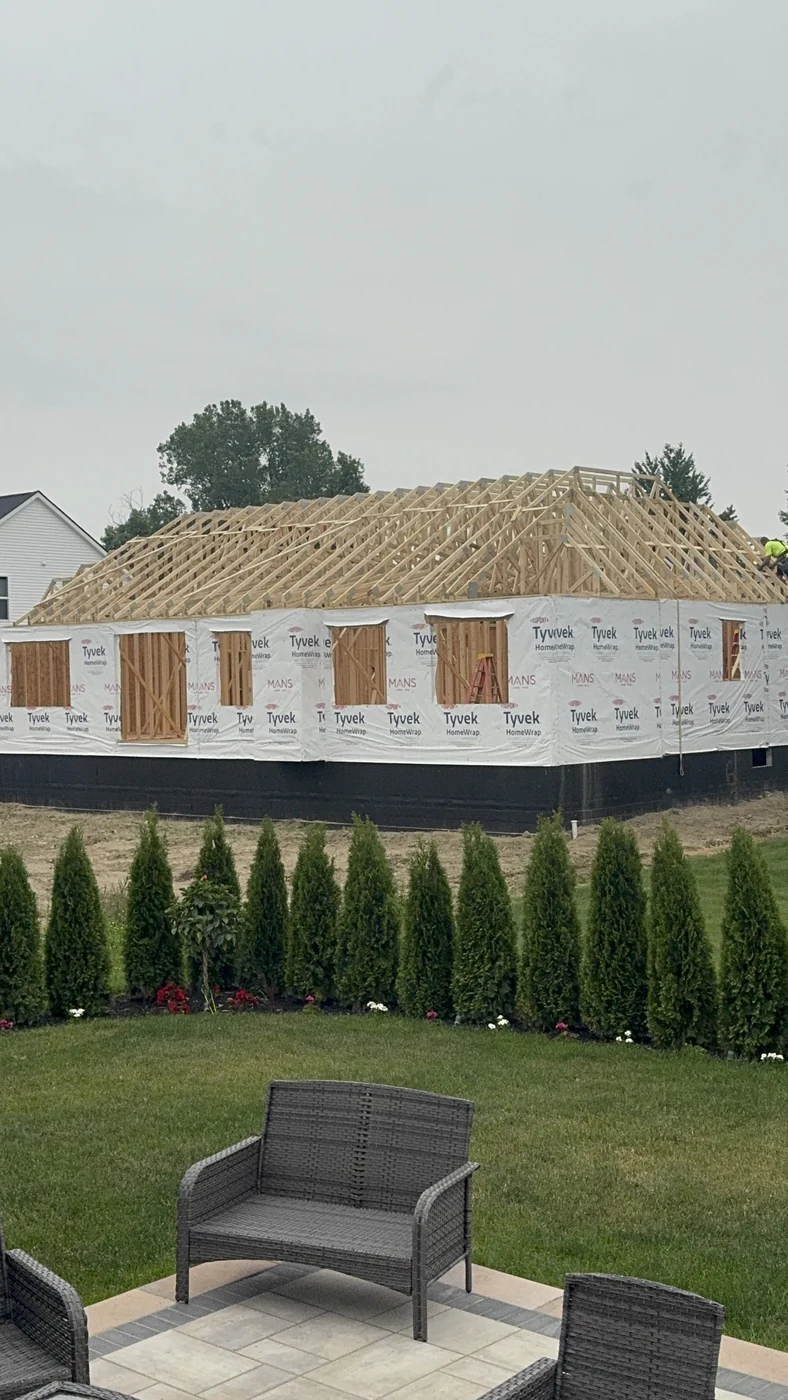
Quite a bit, actually. And the timing is everything.
On a resale home, the inspection happens once, before you commit. The home already exists. You can see how it has aged, how water has moved, and what the previous owners patched. On a new build, the most important inspection window is while the home is still under construction, after mechanical systems are installed but before drywall seals everything behind the walls.
Builder quality control is real. Municipal code inspections happen at required intervals. Neither of those processes is the same as having a licensed inspector working solely for you, reviewing your home, and delivering a report you own. Municipal inspectors verify code compliance. Your inspector evaluates workmanship, installation quality, and issues that affect your comfort and your future costs, including things that meet code but are still done poorly.
This guide covers the full inspection sequence for a new construction home in Southeast Michigan: when to schedule each stage, what to look for, how to document issues, and what Michigan law requires your builder to stand behind after you close.
Buyers who have signed or are preparing to sign a builder contract in Wayne, Oakland, Washtenaw, or Livingston County. Move-up buyers building their first new home after years in resale. And anyone who wants to understand what their inspection rights actually mean before the framing goes up.
Your builder contract determines whether you have the right to bring an independent inspector onto the property. If inspection rights are not written into the contract, the builder can restrict access. This is one of the most important things to negotiate before you sign, not after the footings are poured. Read our Builder Contracts Explained guide for how to request an inspection addendum.
A pre-drywall inspection happens after the framing, rough plumbing, rough electrical, HVAC ductwork, and insulation are installed but before the drywall goes up and covers everything. It is the only point in the entire construction process where a buyer can see inside the walls.
Timing matters. Schedule the inspection too early and the rough-in work is not complete. Schedule it too late and the drywall is already up. Your REALTOR and your inspector coordinate directly with the builder's site supervisor to find the right window. In Southeast Michigan, production homes typically reach this stage six to twelve weeks after framing begins, though timelines vary by builder and community.
The pre-drywall inspection costs $300 to $450 for a typical production home. It takes two to three hours. The inspector delivers a written report with photographs documenting anything that warrants attention. That report becomes part of your record for warranty claims, especially if an issue that was visible at pre-drywall shows up as a problem after closing.
Once the builder's crew installs drywall, the pre-drywall window closes permanently. Do not wait. If your builder notifies you that framing is nearly complete, contact your inspector immediately. A one-week delay can mean the window is gone. Put the inspection date on your calendar the moment framing begins.
Some buyers ask whether the pre-drywall inspection is worth the cost if the builder has its own quality control process. The answer is yes, and here is why. Builder quality control focuses on construction sequence and code compliance. Your inspector focuses on your specific home, your specific systems, and the standards that affect how that home performs for your family over the next ten years. They are looking at different things with different motivations.
The pre-drywall inspection also gives you practical knowledge you will use throughout ownership. You learn where your plumbing supply and drain lines run, which helps you avoid them when mounting heavy items. You learn where your electrical circuits are routed, which helps when planning a basement finish or workshop. You see where insulation was installed and where it might be thin, which helps you anticipate energy performance in Michigan winters.
I ask clients to take photos during the pre-drywall visit, too, not just their inspector. Walk every room and photograph the framing, outlets, plumbing stubs, and HVAC runs from multiple angles. Your phone camera gives you a personal visual record that complements the formal inspection report. Five years from now, when a plumber needs to know where a drain line runs under the slab, you will be grateful you have that photo.
A qualified pre-drywall inspector reviews systems and installations that will be inaccessible after the walls close. Here is what a thorough pre-drywall inspection covers in a Southeast Michigan new build.
The inspector checks that framing members are properly sized, spaced, and connected. Common framing issues include cut or notched joists where a trade ran a pipe through a structural member without proper reinforcement, improper blocking at beam connections, and rafters or trusses that are not fully seated or fastened to code. These are workmanship issues that affect structural integrity, not design choices.
All rough-in wiring is visible before drywall. The inspector verifies that outlet and switch boxes are properly positioned and anchored, wire gauge is appropriate for circuit loads, junction boxes are accessible, and the service panel is correctly sized and labeled. Reversed polarity at outlets, mislabeled breakers, and missing junction box covers are common findings on production homes and are much easier to correct at this stage than after drywall.
Supply lines, drain lines, and vent stacks are all visible. The inspector checks for proper slope on drain lines, secure mounting of supply lines to prevent rattling, correct installation of dishwasher drain loops (commonly missed), and appropriate cleanout access points. In Southeast Michigan, where basements are standard, the inspector also checks the sump pit installation and any rough-in for a future bathroom below grade.
Ductwork routing, return-air sizing, and duct sealing are all visible before insulation and drywall. Improperly sealed duct connections, ductwork routed through unconditioned space without insulation, and undersized return-air grilles all affect heating and cooling performance and are far less expensive to correct now than after finishing.
Insulation placement and coverage in exterior walls, attic kneewall transitions, and rim joists is evaluated. Gaps in air sealing at electrical penetrations, plumbing pass-throughs, and rim joists are one of the most common energy performance problems in new Michigan construction. They cost little to correct during installation and a lot to fix later.
Michigan winters are demanding. A home with gaps in air sealing at the rim joist, an undersized return-air system, or HVAC ducts routed through uninsulated spaces will cost more to heat every year you own it. These are not cosmetic issues. They are energy and comfort issues that affect your monthly bill and your resale value. A $400 pre-drywall inspection that catches them while the walls are open is one of the best dollars spent in any new construction purchase.
As your home approaches completion, the builder will schedule a final walkthrough. This is not an inspection. It is an orientation. A builder representative walks you through the home, demonstrates how systems operate (thermostats, range, ventilation fans, garage doors, circuit panel), and records items you identify as incomplete or needing attention before closing.
The walkthrough is useful. You learn where your shut-off valves are, how your smart home features are programmed, and how to maintain specific products the builder installed. That knowledge has real value.
The walkthrough is also limited. The builder representative is noting what the builder chooses to add to the punch list. They are not conducting a systematic evaluation of your home's mechanical systems, air quality, or installation quality. They are showing you features and documenting agreed-upon items.
Do not sign any document at the builder walkthrough that indicates your acceptance of the home's condition as complete or satisfactory without first completing your independent final inspection. Some builder walkthrough documents are written in language that could be interpreted as a release of warranty items. Review anything you sign with your REALTOR before the walkthrough appointment.
Arrive at the builder walkthrough with your own printed checklist. Walk slowly. Open every cabinet. Test every outlet and switch. Run every faucet. Flush every toilet. Operate every door and window. Note anything that does not look finished or does not work correctly. You want the builder's representative to add every incomplete item to the formal punch list while you are standing there, not after you have gone home.
Take photos and video during the walkthrough. Document what you find and the builder's acknowledgment. A written punch list signed by both parties before you leave is the clearest record of what the builder has committed to complete.
I tell clients to schedule their builder walkthrough and their independent final inspection in the same week, with the independent inspection first. That way you arrive at the builder walkthrough already holding your inspector's report. You are not guessing at what to look for. You have a professional document telling you exactly what to discuss.
When the home is nearing completion, usually within two weeks of closing, schedule an independent final inspection with the same licensed inspector you used for pre-drywall, or a comparably qualified professional. This inspection costs $350 to $550 and typically takes two to four hours depending on square footage.
The final inspection covers everything a standard resale inspection covers: roof, exterior, electrical, plumbing, HVAC, interior rooms, windows, doors, and appliances. It also looks specifically at items unique to new construction: grading around the foundation, window and door sealing, drywall finishing quality, stair construction, and basement moisture conditions during Michigan weather.
New construction homes regularly generate inspection findings. That is not a criticism of any particular builder. It is a reality of production construction, where dozens of trades work sequentially on dozens of homes simultaneously. No production build is perfect. The goal is to find the issues while the builder's warranty, crew, and goodwill are all pointed in the same direction: toward completing your home correctly.
The builder walkthrough shows you how the home works. The independent inspection shows you whether the home was built to the standard you are paying for.
Your inspector's final report becomes one of your most important documents at closing. It establishes a documented condition baseline for the home on the day you take possession. If a warranty issue arises in year one, you can point to the inspection report to show what was or was not present at closing. That documentation protects you from builders who might otherwise argue that a defect was caused by your use of the home rather than by original construction.
The final inspection evaluates the finished home, including items that were not installed at pre-drywall: all interior finishes, drywall, paint, flooring, cabinetry, countertops, fixtures, appliances, doors, windows, trim, and exterior grading, sod, drainage swales, and driveway. The inspector tests all systems under live conditions. HVAC is run. Faucets are operated. Every outlet is checked. The garage door opener safety reversal is tested. The sump pump is evaluated.
Our general Home Inspection Guide covers how inspections work across all Michigan home purchases, including resale, specialty inspections, and how to read an inspection report.
A punch list is the formal record of items the builder has agreed to complete or correct before or shortly after closing. Every new construction buyer will have one. The question is whether yours is written, signed, and specific, or verbal and forgotten.
Start building your punch list the moment your pre-drywall inspection report arrives. Add to it at the final inspection. Finalize it at the builder walkthrough. Every item on the list needs three things: a clear description of what is wrong or missing, a photograph documenting the condition, and the builder's written acknowledgment that the item will be addressed.
| Item Category | Document This Way | Before or After Closing |
|---|---|---|
| Drywall imperfections (nail pops, tape gaps) | Photo + written builder acknowledgment | Typically after closing, within warranty year one |
| Grading or drainage issues | Photo + video showing water direction | Before closing if possible; document immediately after if discovered post-closing |
| Missing or misaligned fixtures | Photo against selections sheet | Before closing |
| Paint touch-ups and scuffs | Photo with room and wall identified | Before closing, during walkthrough |
| Cabinet alignment and hardware gaps | Photo showing gap or misalignment | Before closing |
| Window and door operation issues | Video of sticking or misalignment | Before closing |
| Appliance function problems | Note make, model, and specific failure | Before closing if discovered; warranty claim after |
| Incomplete landscaping or sod | Photo and comparison to contract scope | Before closing if within contract scope |
Not every punch list item must be resolved before closing. Production builders routinely close on homes with open items, particularly cosmetic finishes and seasonal items that require weather conditions not present at closing. What matters is that the open items are documented in writing with a timeline. A completion date or a credit holdback in escrow are both reasonable tools for managing items that will genuinely be completed post-closing.
Items you should not close without include: significant mechanical issues (HVAC not functioning, outlets with no power, plumbing not draining), grading problems that direct water toward the foundation, structural concerns raised in the independent inspection, and items that represent contract compliance (if your contract says oak hardwood was included, accept oak hardwood, not a substitution).
Review the closing documents for any language that could release the builder from punch list obligations. Statements indicating "buyer accepts home in current condition" or "all improvements have been made to buyer's satisfaction" should be reviewed with your REALTOR and possibly a real estate attorney before signing. Your written punch list should be referenced in or attached to any such language.
Michigan's New Home Buyer Protection Act (MCL 408.551 et seq.) establishes mandatory warranty periods for new residential construction. Every new home sold in Michigan is covered, regardless of what the builder's written warranty document says or does not say. Statutory coverage and builder warranty coverage work together, and both require proper notice and documentation to enforce.
Understanding what each period covers, and when it expires, is the foundation of protecting your new home investment.
The Michigan statutory warranty sets minimum periods. Your builder's written warranty document may provide additional coverage or define the claims process more specifically. Read the warranty document you receive at closing. Understand both the statutory floor and the builder's contractual commitments. Where the builder's document offers more protection than statute, you benefit. Where it attempts to provide less, the statute governs.
The Michigan New Home Buyer Protection Act covers the original buyer of the home. In most cases, if you sell the home before the warranty periods expire, the remaining coverage does not automatically transfer to the buyer. The specifics depend on your builder's written warranty document. For new construction buyers in communities across Southeast Michigan, from Canton and Saline to Lyon Township and Howell, this makes the inspection record and documentation you build before closing even more valuable. It is your personal evidence layer on top of what statute provides.
For an overview of how the Certificate of Occupancy fits into this picture, see our Certificate of Occupancy guide. The CO confirms code compliance at closing. It does not replace the warranty and does not cover workmanship or systems performance beyond minimum code.
Most builders provide an online warranty portal or a designated warranty service contact for new construction owners. The process seems simple. In practice, the documentation you bring to that claim determines how quickly and completely it gets resolved.
Photograph the defect clearly. Include context shots (what room, what wall) and close-up shots (the specific crack, gap, or failure point). Note when you first observed the issue and whether it has changed. Write a one-paragraph description of what you see and how it affects the home's use or condition.
Use the builder's official warranty submission channel, usually an online portal or a certified letter address. Keep a copy of everything you submit, including confirmation numbers or delivery receipts. Verbal warranty conversations do not create a clear record. Written submissions do.
If the defect was noted in your pre-drywall or final inspection report, cite it in your warranty claim. You can say: "This condition was documented in our independent inspection report dated [date]. A copy is attached." That reference establishes that the issue existed before or at the time of closing, which is relevant when a builder tries to attribute a defect to post-closing wear or homeowner use.
If a claim is not acknowledged within the timeframe the builder's warranty document specifies, follow up in writing and note that the original claim was submitted on a specific date. Keep every communication in a single folder, physical or digital, labeled by address and organized by claim date. That folder is your protection if a dispute escalates.
Defect: Basement floor drain does not drain properly. Standing water observed after normal water heater maintenance. First observed October 2026, three months after closing.
Supporting documentation: Photo dated 10/14/2026. Independent final inspection report dated August 2026 noted drain slope concern (see attached, page 7). Submission via [builder] warranty portal, confirmation number [xxx].
Requested resolution: Evaluation and repair by licensed plumber within the two-year systems warranty period (closing date August 2026).
One-year workmanship warranty items are the most commonly missed because buyers do not know to look for them systematically. Set a calendar reminder for 11 months after your closing date to walk the home room by room with fresh eyes: nail pops, drywall seams, trim gaps, grout cracking, and paint separation at caulked joints. Submit any findings in writing before the one-year anniversary. After that date, these items shift from builder responsibility to owner maintenance.
This is not a list designed to alarm you about new construction. New homes are worth buying and the process is worth doing right. This is a practical inventory of the issues that show up most often on pre-drywall and final inspections in Wayne, Oakland, Washtenaw, and Livingston counties. Knowing what to look for, and when to expect it, is how you protect the investment you just made.
Improper grading around the foundation is the most consequential and most common issue we see after closing. Michigan soil settles, and production builders frequently grade to minimum code at the time of closing. That grade can flatten or reverse within the first full freeze-thaw cycle. Water that sits against the foundation, rather than running away from it, is one of the leading causes of basement seepage in homes less than two years old. Walk the perimeter of your home after every significant rain in year one. Note where water pools.
Rim joists, the horizontal framing members where your foundation walls meet your first-floor framing, are one of the highest-heat-loss locations in a Michigan home. Production builders often install insulation but skip thorough air sealing at this location. The gap is small. The cumulative energy loss over a Michigan winter is not. This is best caught at pre-drywall but can also be detected with a blower door test by an energy auditor.
New lumber dries and shrinks as a home goes through its first heating season. This is normal. The result is nail pops and tape joint cracks in drywall, typically appearing in winter or early spring of year one. These are workmanship warranty items. They are cosmetic. Document them at your 11-month walk-through and submit a single organized claim rather than calling the builder every time you see one.
Production homes have dozens of outlets, switches, and circuits installed by crews under schedule pressure. Reversed outlet polarity, mislabeled breakers, and outlet boxes wired to the wrong circuit are common findings on final inspections. These are easily corrected by an electrician if caught before or shortly after closing. Budget a few hours of electrical work if your inspector finds multiple instances, and request builder correction of any findings before closing.
A dishwasher drain line should loop up to the underside of the countertop before connecting to the drain to prevent backflow. This step is missed on a surprising percentage of new construction homes. It is a quick fix but requires someone to know it was skipped. Your inspector will check for it.
Attic knee walls and the transitions between conditioned and unconditioned space are frequent gaps in insulation coverage. In a Michigan home, this translates directly to higher heating costs and potential ice dam formation at the eave line. Pre-drywall is the ideal time to catch this.
Most of these issues are resolved cooperatively when they are documented properly. Production builders in the Canton, Saline, Brighton, and Novi markets work with buyers and agents regularly and generally respond to well-documented warranty claims. The goal is not conflict. The goal is a home that performs as built and a relationship with your builder's warranty team that is clear and organized from day one.
New construction is one of the most exciting purchases a family can make. You get to choose your community, your floor plan, your finishes, and your start. You also take on a build process that spans months and involves dozens of decisions, some of which are not visible to you until an inspector makes them visible.
The inspection strategy is simple: two independent inspections (pre-drywall and final), a thorough builder walkthrough with your own checklist, a written punch list signed before closing, and a clear understanding of the three warranty periods that protect you after you have the keys.
We walk through this process with every buyer we represent on new construction. From the contract review and inspection rights negotiation to the builder walkthrough and the first-year warranty reminder, our goal is that you close with confidence and own your home with clarity. If you are building in Canton, Northville, Brighton, Saline, Lyon Township, or anywhere across Southeast Michigan, we are glad to be part of your team from the first model home tour through the final punch list.
This guide provides general educational information about new construction inspections and Michigan warranty law for Southeast Michigan buyers. It is not legal advice. Builder contracts, warranty documents, and claim procedures vary. Consult a qualified Michigan real estate attorney for guidance on your specific contract or warranty dispute. Michigan statutory warranty information is current as of the guide's review date. Verify current statute language at michigan.gov or with a licensed Michigan real estate attorney.
No. Michigan does not require buyers to conduct a pre-drywall inspection. Builders run their own quality control and municipal inspectors check code compliance at required stages. A buyer-hired pre-drywall inspection is optional but strongly recommended. It is the one window where electrical, plumbing, insulation, and framing are all visible before walls close. Once drywall is installed, many of those systems are inaccessible without destructive investigation.
If your contract does not include inspection rights, the builder can restrict access. This is why your REALTOR should negotiate an addendum permitting pre-drywall and final buyer inspections before you sign the purchase agreement. Production builders vary: some welcome inspectors, others require inspection rights to be explicitly written into the contract. For more on contract negotiation, see our Builder Contracts Explained guide.
A pre-drywall inspection typically runs $300 to $450 for a production home in Wayne, Oakland, Washtenaw, or Livingston County. A final inspection runs $350 to $550 depending on square footage. Radon testing for a new build is $125 to $175. Budget $700 to $900 if you schedule both stages. The cost is modest relative to what an undetected air sealing gap, reversed drain line, or grading problem will cost in energy bills or repairs over the first three years of ownership.
Michigan's New Home Buyer Protection Act (MCL 408.551 et seq.) sets three warranty periods: one year for workmanship defects such as drywall finishing, trim gaps, and improper caulking; two years for mechanical systems including plumbing, electrical wiring, and HVAC; and ten years for structural defects affecting load-bearing elements. Builders must also provide a written warranty document at closing. Statutory coverage and the builder's written warranty work together, but both require timely written notice and documentation to support a valid claim.
The Michigan 1-2-10 framework sets the coverage periods, but the builder's written warranty governs the specific notice and claim procedure. Most require written notice within the applicable warranty period. Do not rely on verbal conversations. Photograph the defect, describe it in writing, submit it through the builder's official warranty portal or by certified mail, and keep copies of everything. Missing a notice deadline can void an otherwise valid claim.
The builder's final walkthrough is a tour led by a builder representative to show you how systems operate and document items the builder agrees to add to the punch list. It is an orientation. An independent final inspection is conducted by a licensed inspector hired by you, working only for you, with no obligation to the builder. We recommend scheduling your independent inspection before the builder walkthrough so you arrive with your own report already in hand.
This is common. Production builders frequently close on homes with open punch list items. Before closing, get the outstanding items in writing with a committed completion timeline. Some buyers request a closing credit or a repair escrow holdback to ensure work is completed after closing. Your REALTOR helps you decide what is reasonable to accept versus what must be resolved first. Never close without a documented, signed list of what remains open.
Yes, if your schedule allows. Attending the pre-drywall inspection helps you understand where your electrical circuits, plumbing lines, and insulation are located, practical information for hanging shelves or planning a basement finish. Attending the final inspection lets you ask questions in real time and understand which findings are urgent versus routine. Being present for both stages puts you in a much stronger position at the builder walkthrough.
Yes. Michigan municipalities issue a Certificate of Occupancy (CO) after the home passes local code inspections. The CO confirms the home meets the Michigan Building Code for occupancy. It is not the same as a buyer inspection. Municipal inspectors verify code compliance; your inspector verifies workmanship, installation quality, and items beyond minimum code. For a full explanation of how the CO works, see our Certificate of Occupancy overview.
The issues we most commonly document on new construction inspections in Wayne, Oakland, Washtenaw, and Livingston counties include improper grading that directs water toward the foundation, gaps in air sealing at rim joists and top plates, reversed electrical outlets or mislabeled circuit breakers, missing dishwasher drain loops, incomplete vapor barriers, and first-season drywall nail pops and tape joint cracking. These are all fixable. The goal of the inspection is to document them before or shortly after closing, while the warranty applies.
Every home purchase is unique, and every builder, community, purchase agreement, lender, municipality, and title company may have different policies, timelines, requirements, and procedures.
The information in this guide is provided for educational purposes to help you better understand the new construction process and ask informed questions along the way. It is not intended to replace the guidance of your REALTOR®, builder, lender, inspector, attorney, title company, or other professionals involved in your transaction.
Builder policies regarding third-party inspections, construction access, walkthroughs, warranties, completion standards, timelines, and closing procedures can vary. Always review your builder’s specific requirements and consult with the appropriate professionals regarding your individual situation.
If you’re buying a new construction home in Southeast Michigan, we’re always happy to answer your questions and help you understand what applies to your specific home, builder, and community.
A new home is a big commitment. The inspections are how you make sure what you signed for is what was actually built.
We represent buyers on new construction in Canton, Northville, Brighton, Saline, Lyon Township, South Lyon, Novi, and communities across Wayne, Oakland, Washtenaw, and Livingston counties. We coordinate inspection access with builders, attend walkthroughs, manage punch lists, and make sure our clients close with documentation that protects them for years. If you are navigating a new build right now or planning one, we are glad to talk through the inspection strategy and the full process.
The Hearts to Homes Team
Real Estate One · Plymouth, Michigan
Call or text: (734) 323-4486 · derica@heartstohomesmi.com